
For trade buyers sourcing Murano glass pieces, verifying authenticity is a critical step that protects both reputation and investment. The market includes many pieces that claim to be from the island of Murano, but not all carry genuine credentials. A Murano glass certificate of authenticity is one of the most reliable ways to confirm that an artwork was hand-blown in Venice, Italy. This guide examines the different types of certificates, their strengths and limitations, and additional verification methods that help trade buyers make informed purchasing decisions.
Why Certificates Matter for Trade Buyers
Antique stores, furniture showrooms, lighting distributors, interior designers, and other trade professionals depend on the provenance of the items they sell or specify. A fake Murano glass piece can damage client trust and create liability. A certificate of authenticity provides a documented link between the object and its origin on the island of Murano. For trade buyers, possessing a verifiable certificate adds value when reselling or installing the piece in high-end projects. It also streamlines communication with clients who ask for proof of origin. While no single method guarantees authenticity beyond all doubt, a proper certificate from a reputable source significantly reduces risk.
Traditional Certificate of Origin Stickers
The most traditional method for confirming authenticity is the certificate of origin sticker. This adhesive label is affixed to the piece and typically certifies that the artwork was created on the island of Murano, Italy. For many decades, these stickers served as the standard proof for collectors and trade buyers. However, trade buyers should understand the differences between older paper stickers and newer digital alternatives.
Other Signs of Authenticity
Certificates are not the only indicators of genuine Murano glass. Combining multiple verification methods gives trade buyers a more complete picture. Two particularly useful physical markers are the glass master’s signature and the punt mark.
The Glass Master’s Signature
Many Murano glass masters sign their artworks. The signature can appear as an engraved marking, an applied gold or colored script, or a branded stamp on the base of the piece. To verify the signature, trade buyers can research the name online to confirm that the master is located in Murano, Italy. However, not all pieces are signed. For aesthetic reasons, masters often do not sign glasses, carafes, mirrors, and chandeliers. In those cases, a signature may be absent even on an authentic piece. Therefore, the lack of a signature does not automatically indicate a fake. It simply means the buyer must rely on other indicators such as a certificate of origin or physical craftsmanship marks.
Punt Marks and Handmade Irregularities
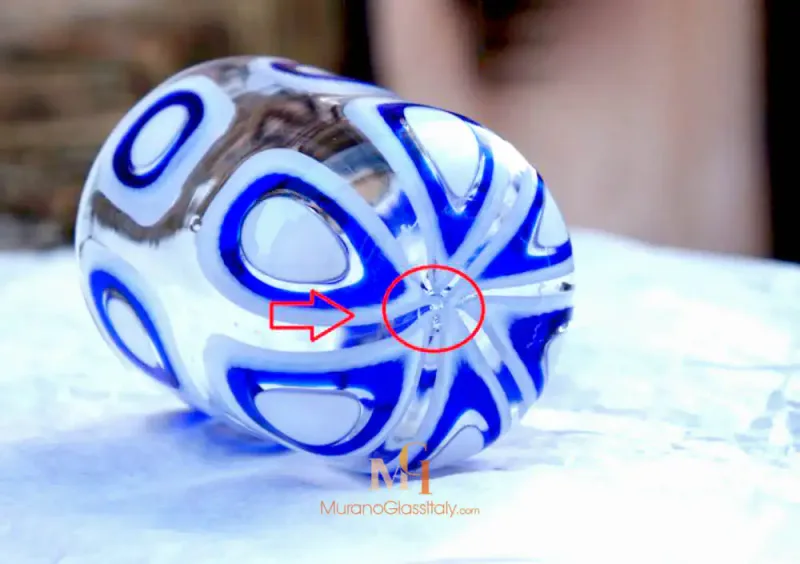
Hand blown Murano glass almost always carries a punt mark on the base. This is the scar left by the pontil rod used to hold the glass during shaping. If the base is completely smooth and free of any punt mark, the piece is likely mass produced and may be a copy. Trade buyers should also look for other handmade irregularities such as slight asymmetries, tiny bubbles trapped in the glass, or variations in color thickness. These imperfections are hallmarks of mouth blown glass produced by human skill rather than by mold. While punt marks are common, some pieces may have ground or polished bases that remove the mark. In that situation, other signs of hand crafting become even more important. Checking for even seams would be a red flag because authentic Murano glass is blown, not molded.
.
Frequently Asked Questions
What information should a Murano glass certificate of authenticity contain?
A genuine certificate typically includes the name of the artwork, the name of the glass master or furnace, and the year of creation. Digital NFT certificates also include a unique NFT code and a permanent record on the blockchain. Trade buyers should confirm that these details match the physical piece and that the certificate comes from a reputable source.
Is a paper sticker still a reliable proof of authenticity in 2025?
Paper stickers are easily forged and are mainly reliable for older pieces created before 2024. For recent artworks, a paper sticker alone does not guarantee authenticity. Trade buyers should treat paper stickers as supporting evidence rather than conclusive proof, and combine them with other checks such as the master’s signature or punt marks.
How can I tell if a Murano glass piece is hand blown without a certificate?
Look for a punt mark on the base. Hand blown glass usually leaves this scar from the pontil rod. Also examine the piece for slight asymmetries, tiny bubbles, or irregular color distribution. If the base is completely smooth or the piece has visible mold seams, it is likely mass produced. A missing signature does not rule out authenticity because some items like chandeliers are not signed for design reasons.
For trade buyers, the combination of a proper certificate, a known glass master’s signature, and visible hand crafting marks provides the strongest confidence in authenticity. Always source from established distributors who can document the origin of their Murano glass and who stand behind the pieces they sell. By understanding the strengths and limits of each authentication method, you protect your business and deliver genuine Venetian artistry to your clients.